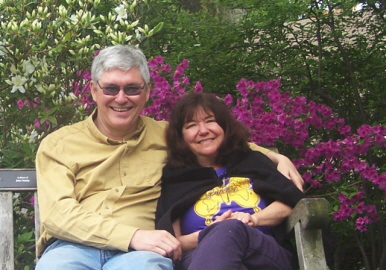
This is the homepage of Robert Styer,
Department of Mathematics and Statistics, Villanova University,
800 Lancaster Avenue, Villanova, PA 19085-1699 USA
Office: Saint Augustine Center (SAC) 372
Phone: (610) 519 4845
e-mail: robert DOT styer AT villanova
DOT edu
Director of the
Comprehensive
Science Program.
More info
about our program major.
Info about the
Laboratory Sciences minor.

Office Hours:
See syllabi on Blackboard. I prefer meeting by appointment (call or email
me anytime to set up a time)
Some Educational Modules I enjoyed making
Bouncing Balls Module: An introduction to geometric series, published in the Journal
of Online Mathematics and its Applications, Volume 7, 2007.
Tower of Blocks and
Harmonic Series Module An unfinished introduction to harmonic series.
Geometric constructions with ruler and compass, or
ruler, or compass: Trisecting a Line Segment, LOCI Online
Journal Feb 2010
link
Misc:
My favorite senior seminar class model.
An article by Stearns giving advice on surviving graduate school (pdf).
In Sept 2010 the Villanovans for Life campus group invited several professors to discuss how their prolife views intersect with their professional life; here is my one page statement (pdf, Word).
 Research interests:
I am interested in analytic and elementary number theory. My thesis involved Hecke
theory over number fields. I have been
working with Reese Scott (a musician/composer who does math on the side to
relax!) on Diophantine equations research.
Here are some articles and other work we have
done on exponential Diophantine equations.
I also enjoy creating educational modules:
Bouncing Balls Module: An introduction to geometric series, published in the Journal
of Online Mathematics and its Applications, Volume 7, 2007.
Tower of Blocks and
Harmonic Series Module An unfinished introduction to harmonic series.
Geometric constructions with ruler and compass, or
ruler, or compass: Trisecting a Line Segment, LOCI Online
Journal Feb 2010
link (student
presentation
nicely summarizing the proofs)
Here is a paper on Three: Lines, Triangles and the Trinity written for the November 2001 Experiences of God in the Disciplines Sophia Papers conference.
Article in SIAM NEWS October 1997 on industrial mathematics pdf
Research Productivity and Pareto's Law, in the Fall 2003 The Department Chair pdf
I have also worked on happy numbers, inspired by one of our senior seminar students in Spring 2008. Some Info on consecutive happy numbers. Another seminar student explored multiplicative persistence.
Around 2005 a group headed by MaryAngela Papalaskari developed a Magic School which taught STEM ideas to high school students using Harry Potter as the hook. These papers contain some information about this.
Papalaskari, M. A., Hess,
K. L., Lagalante, A. F., Nadi, N., Styer, R. A., Way, T. P., Weinstein, R. D.
(2007). Work in Progress: Engineering the Magic School - Creativity and
Innovation in Context. 37th ASEE/IEEE Frontiers in Education Conference.
Papalaskari, M. A., Hess,
K., Kossman, D., Metzger, S., Phares, A. J., Styer, R. A., Titone, C., Way, T.
P., Weinstein, R. D., Wunderlich, F. J. (2006). PIVOTS: Service Learning at the
Science, Theatre & Magic Boundary. 36th ASEE/IEEE Frontiers in Education
Conference, 18-23.
In 2021-2022 I had the privilege of helping with a "gamefication" computer science teaching grant which resulted in this paper: Dicheva, D., Cassel, L., Styer, R., Dichev, C., Guy, B., Irwin, K. (2022). An Empirical Study of the Effects of Virtual Currency on Learners in Out of Class Practicing. In: Hilliger, I., Muñoz-Merino, P.J., De Laet, T., Ortega-Arranz, A., Farrell, T. (eds) Educating for a New Future: Making Sense of Technology-Enhanced Learning Adoption. EC-TEL 2022. Lecture Notes in Computer Science, vol 13450. Springer, Cham. https://doi.org/10.1007/978-3-031-16290-9_6 https://link.springer.com/chapter/10.1007/978-3-031-16290-9_6
My wife Peggy has a degree in early
childhood education from Ohio State, and sees Ohioans as the epitome of goodness. She is
intelligent; in our premarital counseling personality test, Peggy scored 70 percent on the
abstract reasoning, while I scored 30 percent (together we
are 100%!). She has a sanguine personality, and we
all too often talk till the wee hours of the morning. (quite old photo
and another old photo of us at the azalea
garden, the location of an important date many years ago.) Peggy is a certified Wilson
reading tutor. 
We have eight children. Amy is married to Fadi Greene and is a biochemistry professor at Albright, with three children. Melanie works for the USDA as a food inspector. Joe is married to Wei, with 2 children, and works for Capital One. Andy works for the Veteran's Administration. David is in twelfth grade and Daniel is in ninth. The twins, Sahari and Mariah, are eleven.
An interesting Styer family history blog:
 https://styerstories.family.blog/author/dopplichdutchman/
Pictures on the right: 50th Styer Reunion 1998 (on grass), Hill Reunion 2011
(at Camp Epachiseca).
My dad was one of 12, my mom one of 9, so I have lots of cousins!
Finding Math Facts
Math Organizations
Math Software
Fun Math Pages
Math Teaching Service Opportunities
Misc Math
Math Lesson Plans Lesson Planet helps math teachers quickly find teacher-reviewed online math lesson plans and worksheets.